
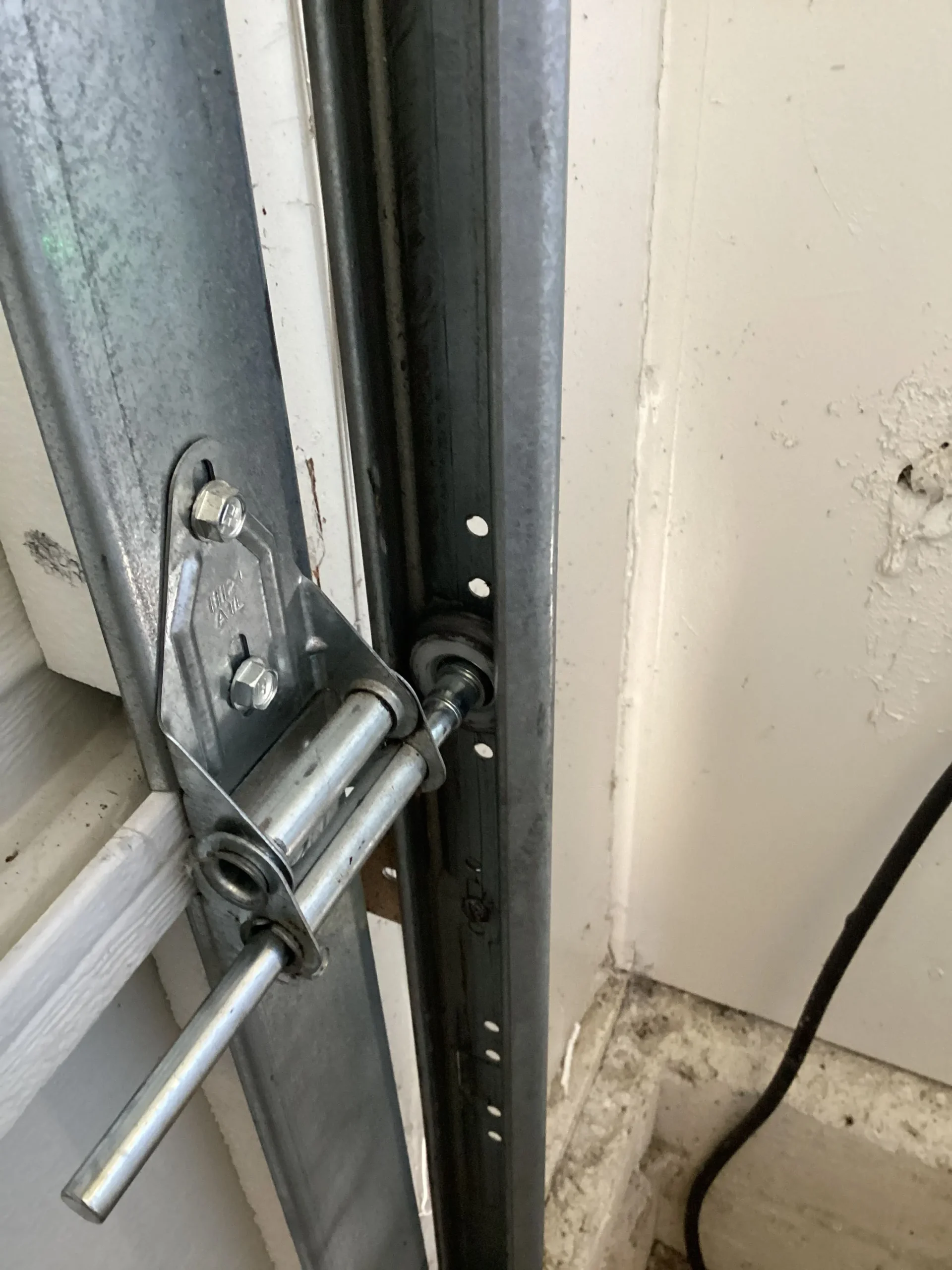

Walk to the back of your garage, stand under the rear end of one horizontal track, and sight along it toward the door opening. If the track was hung correctly, the end nearest you sits slightly lower than the end at the curve. It is a small drop over a run of several feet, easy to miss, and entirely deliberate. That backward slope is what holds your door against the opening when it is closed and what keeps it from drifting forward when it is open.
Local Garage Doors hangs and corrects track across California, Nevada, and Arizona and holds thousands of 5-star ratings on Google, Yelp, Facebook, and Thumbtack, and flat or forward-pitched horizontal track is one of the more common things we find behind a door that seals badly and rattles in the wind.
If your door will not sit tight against the weather seal, or it creeps once it is open, this article explains the specification behind it. For same-day service, call  866-337-1631,
 email info@localgaragedoors.com, or schedule your appointment today.
Should Garage Door Horizontal Tracks Be Level?
No. Horizontal garage door tracks are pitched intentionally, sloping slightly downward toward the rear of the garage, away from the door opening. The slope pulls the closed door inward against the weather seal and stops the open door drifting forward. A track that is level or sloped forward causes poor sealing, rattling, and creeping.
What the Slope Actually Does
To see why, it helps to picture the door’s travel as two distinct phases, which how garage doors work walks through in full.
Once the door is past the curve and travelling horizontally, gravity is no longer lifting or lowering it. It is acting along the track. Which direction that component points is decided entirely by the pitch.
With a correct backward slope, three things follow:
The door is pulled back against the opening as it closes. As the top section comes down through the curve, the rollers in the horizontal run are riding slightly downhill toward the rear, which keeps the whole door loaded toward the jamb rather than hanging loose. That is what makes the weather seal compress evenly along its length.
The open door stays where it is put. A door parked overhead on a level track has nothing holding it, and any vibration or air movement can start it drifting toward the opening. On a back-pitched track, it settles rearward and stays.
The rollers stay seated in the track. Consistent loading in one direction keeps each roller against the same face of the track through the whole run, rather than rattling between the front and back faces.
Pitch is a small number by design. Too little and the door does not seat. Too much and the door is fighting uphill at the end of its opening travel, which loads the opener and can leave the top section standing proud of the header.
Pitch is also one leg of a three-part geometry. The curved radius section and the back-hang that supports the rear of the horizontal track both have to agree with it, which is why a door that binds near the top is diagnosed across all three rather than by adjusting one. Why the garage door binds near the top works through that split.
How Pitch Gets Set and Lost
Pitch is established when the horizontal track is hung, by the length of the back-hang supports dropping from the ceiling joists to the rear of the track. Longer drop at the rear means more slope.
Both sides have to match. Pitch on one track and not the other puts the door through a twist on every cycle, which is a separate fault from either track being wrong on its own, and it is why pitch is always checked as a pair alongside the alignment checks for plumb and parallel.
Common ways it goes wrong:
- Back-hang cut to a convenient length rather than to the required drop, usually on a rushed install.
- Angle iron that has sagged or bent under load over many years, flattening the slope.
- Lag bolts pulling out of the joist, which drops the rear of the track and over-pitches it.
- A ceiling or joist that is not level, so hangers cut to equal lengths produce unequal pitch.
- Storage racks or equipment bolted to the same joists, shifting or loading the hangers.
- A door replacement where the old track was reused and the new door’s weight changed how the existing hangers deflect. A professional installation re-hangs the horizontal run to the new door rather than inheriting the old geometry.
What Happens When the Pitch Is Wrong
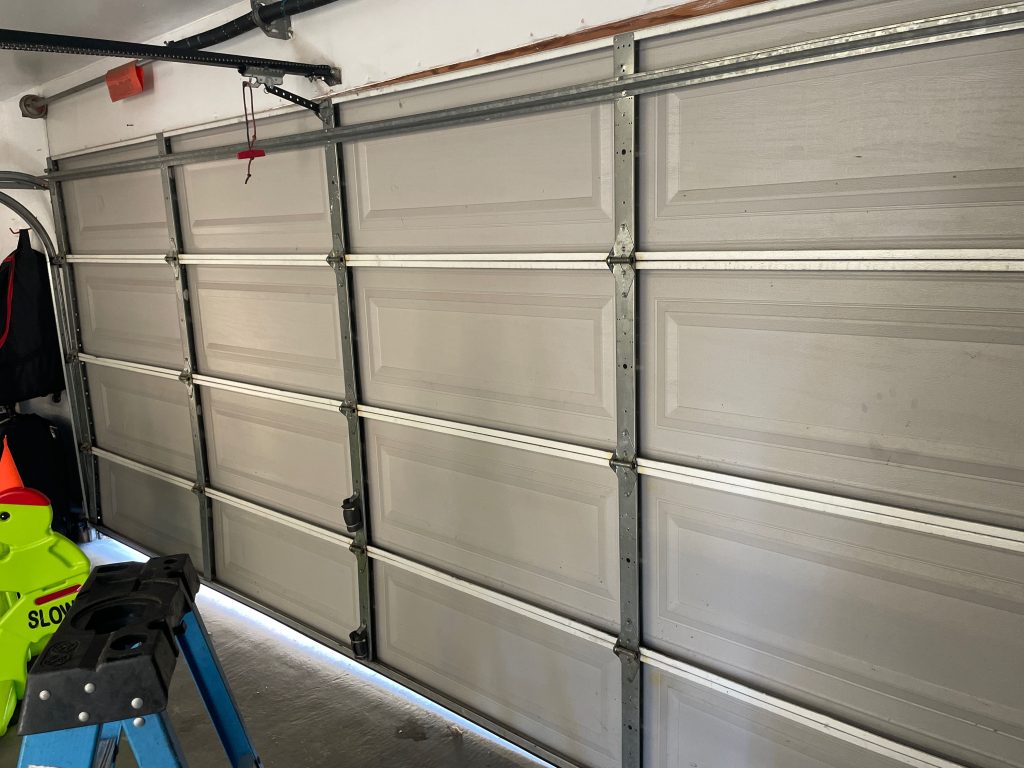
The door will not seal at the bottom. The most common complaint. Light shows under one end, or the weather seal touches without compressing. Owners replace the weather seal and the gap comes back, because the seal was never the problem. A $95 to $195 safety inspection will separate the two in a few minutes.
The door rattles in wind. Nothing is holding it against the jamb, so it moves in its own clearance.
The open door creeps forward. On a level or forward-pitched track, the door slowly travels toward the opening after it stops. On an opener this reads as a travel limit fault.
The door is hard to start closing. With forward pitch the first part of the closing travel is uphill, which an opener interprets as resistance.
Rollers chatter through the horizontal run. Unloaded rollers bounce between the front and back faces of the track, which is noisy and shortens their life.
The door creeps and the opener fights it. A door that will not stay put puts load on the trolley and the opener that the motor was never meant to hold.
The top section stands away from the header when open. Over-pitch pulls the door back and down far enough that it no longer tucks properly.
The door binds where the curve meets the horizontal. Where pitch and radius disagree, the transition is where the door finds out.
Regional Factors Across California, Nevada, and Arizona
Pitch is set against the building, so it moves when the building does. That plays out differently across our California and Arizona markets.
Settling and seasonal soil movement. Sacramento, Stockton, Modesto, Galt, and Dixon garages sit on soils that move with the seasons, and a ceiling that shifts takes the back-hang with it. Pitch set correctly five years ago is worth rechecking here.
Older framing in the Bay Area. Berkeley, Oakland, Alameda, Walnut Creek, and Burlingame garages often have joists that have dried and twisted, so hangers cut to equal lengths no longer give equal pitch.
Wind exposure on the coast. San Diego, Encinitas, Coronado, Half Moon Bay, and Pacifica doors get tested constantly by onshore wind, and a door that is not held firmly against the jamb rattles audibly and wears its seal fast.
Heat in the desert. Phoenix, Scottsdale, Chandler, Goodyear, Las Vegas, and Henderson garages exceed 120°F, reaching 130°F in Phoenix. Long angle iron hangers expand, and lag bolts in hot, dry framing lose grip over time.
Snow load at elevation. Truckee, South Lake Tahoe, and Grass Valley garage roofs deflect under winter load, and anything hung from those joists moves with them.
The Bottom Line
Horizontal garage door track is not meant to be level. It slopes gently down toward the back of the garage, and that slope is what seats the door against the opening and keeps it parked where you left it.
If your door will not seal evenly, rattles in wind, or drifts after it opens, check the pitch before you replace anything. Sight along each horizontal track from the rear and compare the two sides to each other. Equal and slightly downhill toward the back is correct. Level, forward, or unequal is not.
Track straightening runs $150 to $400 and a door adjustment runs $100 to $500, both as totals including parts, labor, and tax. A tune-up and safety inspection at $95 to $195 covers the pitch and alignment check together, and catching it there avoids the roller and seal replacement that bad pitch quietly causes.
Call us at 866-337-1631,
email info@localgaragedoors.com.
🗓️Book an appointment online — same-day service available across California, Nevada, and Arizona.
Fully Licensed, CA #1023930 | NV #0087802 | AZ ROC #356696
Frequently Asked Questions About Horizontal Track Pitch
Should the horizontal track on a garage door be level?
No. The horizontal tracks are pitched slightly downward toward the rear of the garage by design. A level held along the run will correctly show them off level, and that is the intended condition. What should be level is the two horizontal tracks relative to each other across the opening.
Do garage door rails slope?
Yes, the horizontal rails slope gently away from the door opening toward the back of the garage. The purpose is to use gravity to hold the closed door against the jamb and the open door against the rear of its travel. The vertical rails beside the opening are a different matter and should be plumb.
Should garage door rails be level?
Only in one sense. The two sides should match each other, so a measurement taken from the floor to each horizontal track at the same distance from the opening should give the same number. Along their length they should not be level, because the backward pitch is deliberate.
What angle should a garage door opener rail be?
The opener rail runs above and roughly parallel to the horizontal track, rising slightly from the header toward the motor head so the trolley and door arm clear the top section through its travel. It is set from the door’s geometry rather than to a fixed angle, which is why it gets positioned after the track is hung rather than before.
How do you fix a broken garage door track?
A dented or kinked section can sometimes be straightened in place, but a track that is creased or torn at a bracket hole is replaced rather than repaired, since the damaged area will not hold the roller consistently. If the track failed because the door came off, the cause usually needs correcting too, or the new track will fail the same way. Our bent track repair page covers what each case involves.
What is a good slope for a garage floor?
Garage floor slope is a drainage question and is separate from track pitch, though the two do interact at the bottom of the door. A floor that slopes or is out of level affects how evenly the bottom seal meets the slab, so a door that seals badly at one end can be a floor issue rather than a track issue. Checking the floor across the opening before adjusting track is worth the two minutes.
Related Articles:
- Why the Garage Door Binds Near the Top: Radius, Back-Hang and Track Pitch
- Garage Door Rubbing Frame: Strut Issues, Panel Bowing and Track Setback Explained
- Garage Door Won’t Open All the Way: Causes Tied to Travel Limits, Header Interference and Track Geometry
- Track Radius 12″ vs 15″: How It Changes Door Travel, Headroom and Opener Fit