
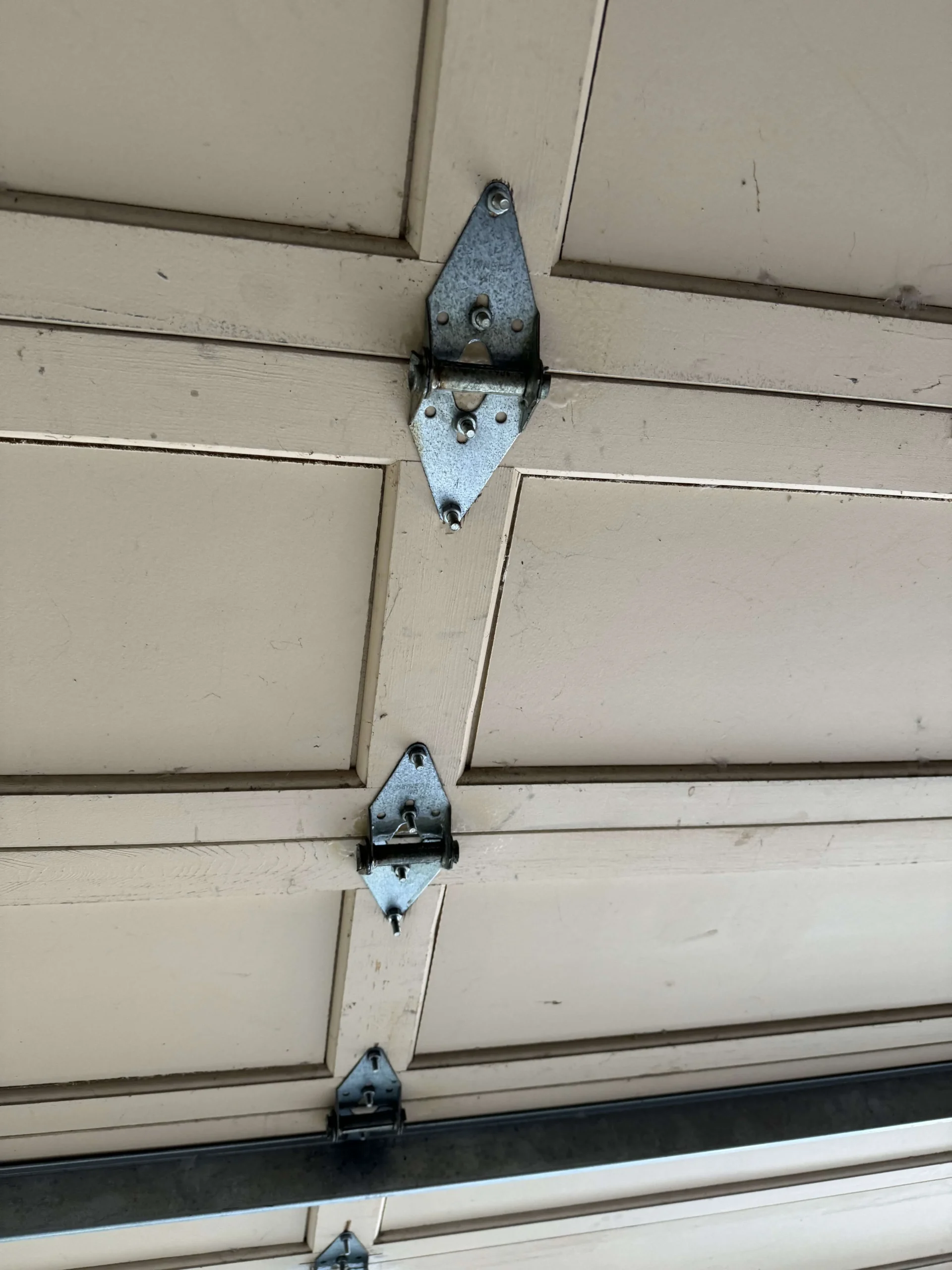

Open your garage door partway and look at the hinges along the seam between two sections, on the inside face. Somewhere on the flat of each one there is a stamped number. Walk along the seam and you will find the same number repeated on the inner hinges, with something different at each end. Those numbers are not batch codes or part counts. They describe the shape of the hinge, and fitting the wrong one is a quiet way to crack panels over a couple of years.
With thousands of 5-star ratings across Google, Yelp, Facebook, and Thumbtack, Local Garage Doors replaces hinges across California, Nevada, and Arizona, and mismatched hinge numbers are one of the quieter causes of cracked panels we find on doors that have had piecemeal repairs.
If you are replacing a hinge or working out why panels keep cracking, this article explains the numbering. For same-day service, call  866-337-1631,
 email info@localgaragedoors.com, or schedule your appointment today.
What Do the Numbers on Garage Door Hinges Mean?
The stamped number identifies the hinge’s offset, meaning how far it holds the roller from the door face. Numbers increase as the hinge moves up the door: #1 hinges sit at the lowest seam, with #2, #3 and higher above them. Higher numbers have greater offset to match the curve of the track.
Why the Offset Has to Change Going Up the Door
This is the part that makes the whole system make sense, and it is rarely explained.
When the door is closed, every section sits in the same flat plane and every roller is in the vertical track. Nothing needs to differ. The complication arrives at the curve.
As the door rises, each section in turn passes through the radius section and rotates relative to the one below it. At the moment a section is partway round that curve, its rollers need to sit at a slightly different distance from the door face than the rollers on the sections still travelling vertically. If every hinge held its roller at the same offset, the sections would fight each other through the turn, and the load would land on the panels and the hinge knuckles.
The numbering solves it. Each hinge position up the door carries a progressively larger offset, so that as each section negotiates the curve, its roller is already held where the track wants it. The door flexes through the radius without the panels taking the strain.
That is also why the numbers are tied to position rather than to the door. A #2 hinge is a #2 hinge whichever door it is on, and it belongs at the second seam up, counting from the bottom. The same logic governs the curved track radius the sections are rotating through, which is why the two specifications have to agree.
Reading the Numbers on Your Own Door
- Numbers are stamped on the hinge face, usually a single digit, sometimes alongside a manufacturer mark.
- Counting begins at the bottom. The seam between the bottom section and the one above it takes #1 hinges. The next seam up takes #2, and so on.
- A four-section door therefore runs #1, #2 and #3 hinges across its three internal seams.
- End hinges carry the rollers. The hinges at the left and right edges of each seam hold a roller stem; the hinges between them, along the middle of the seam, generally do not.
- Center hinges may be unnumbered, because without a roller there is no offset to specify.
- The top fixture and the bottom bracket are not hinges and are not part of the sequence. The bottom bracket in particular is under full cable tension and is never treated as an ordinary hinge.
- Gauge is a separate specification. Hinges come in different steel thicknesses for different door weights, and a correctly numbered hinge can still be too light for a heavy insulated door.
If the numbers on your door do not run in a clean sequence from the bottom up, somebody has fitted the wrong part at some point.

What Goes Wrong When Numbers Are Mixed
Panels crack around the hinge fasteners. The clearest and most expensive symptom. A hinge with the wrong offset puts the section into the curve at the wrong angle, and the panel absorbs the difference on every cycle until the steel fatigues around the screw holes. Panel replacement runs $300 to $800 as a total including parts, labor, and tax.
The door binds at the curve. The section cannot rotate freely into the radius, so the door labors at the same point every cycle. That repeatability is what distinguishes it from a seized component, as covered in door stops at the same spot every time.
Rollers wear on one face. The wrong offset side-loads the wheel, producing the uneven pattern described in roller wear.
Hinge knuckles crack or elongate. The hinge itself takes load it was not shaped to take, and the pin hole wears oval.
The door makes a popping sound at one point. Sections releasing from a bind pop audibly, usually as the affected seam enters or leaves the curve.
The door rubs the frame. Sections held at the wrong depth sit proud, a pattern covered in garage door rubbing frame.
The opener works harder. All of the above is friction, and on a balanced door the motor should only be supplying about 5% of the effort.
A related mistake is replacing a numbered hinge with an unnumbered generic one. If it carries a roller, it needs the right offset, and a hinge chosen on bolt pattern alone will usually be wrong.
Regional Patterns We See
Hinge problems show up faster in some conditions than others, across both our California and Arizona service areas.
Doors with layered repair history. Berkeley, Oakland, Alameda, Martinez, and Vallejo garages with decades of patchwork accumulate mismatched hardware, and hinge numbers are among the first things to drift.
Heat cycling in the desert. Phoenix, Scottsdale, Chandler, Goodyear, Las Vegas, and Henderson garages exceed 120°F and reach 130°F in Phoenix. Thermal cycling works on fasteners, and a hinge already under the wrong load loosens faster.
Salt air on the coast. San Diego, Encinitas, Coronado, Oceanside, and Half Moon Bay hinges corrode at the knuckle and at the fastener, which makes the numbers hard to read and tempts a guess at replacement time.
Heavy insulated doors. Chandler, Anthem, Summerlin, and the Sacramento suburbs run triple-layer insulated doors at 300 to 400 pounds or more, where hinge gauge matters as much as the number and a light hinge fails quickly.
Cold at elevation. Truckee, South Lake Tahoe, Grass Valley, and Carson City doors run stiffer in winter, so a marginal hinge geometry that was tolerable in July starts cracking panels in January.
The Bottom Line
Hinge numbers describe offset, and offset increases as you move up the door because each section needs its roller held slightly further out to negotiate the curve cleanly.
Count from the bottom seam up, match the number that comes off to the number that goes on, and check the gauge as well as the number if the door is a heavy insulated one. If the sequence on your door does not run cleanly from #1 upward, something has been swapped and the panels are paying for it.
A cracked hinge is a cheap part. The cracked panel it eventually causes is not, and that is the whole argument for getting the number right.
Call us at 866-337-1631,
email info@localgaragedoors.com.
🗓️Book an appointment online — same-day service available across California, Nevada, and Arizona.
Fully Licensed, CA #1023930 | NV #0087802 | AZ ROC #356696
Frequently Asked Questions About Garage Door Track Radius
How are garage door hinges numbered?
Numbering runs from the bottom of the door upward. The hinges at the first seam, between the bottom section and the one above, are #1. The next seam up takes #2, then #3, and so on. The number denotes the hinge’s offset, which increases as you go up so each section can rotate correctly through the curved section of track.
What type of garage door hinge do I need?
Match three things: the number, which must suit the seam position counting from the bottom; the gauge, which must suit the door’s weight; and whether the position carries a roller. The simplest approach is to remove the old hinge and match its stamped number and thickness rather than selecting on bolt pattern, since a hinge that bolts up correctly can still have the wrong offset.
Where do garage door hinges go?
Along every horizontal seam between sections. Each seam has a hinge at the left edge and the right edge, both of which carry rollers, plus one or more center hinges spaced along the seam that do not. Taller and wider doors carry more center hinges per seam to spread the load.
What are the signs of a broken garage door hinge?
A popping or banging sound as the door passes a particular point, visible cracking in the hinge body or around its fasteners, a hinge knuckle that has worn oval, a section that looks slightly out of line with the ones above and below, and panel metal that is deformed or cracked around the hinge screws.
How to replace a broken garage door hinge?
With the door closed and the opener disconnected, the hinge is unbolted and the replacement fitted with matching number and gauge, taking care that the roller stem seats fully in the sleeve. Hinges are replaced one at a time so the seam stays supported. The bottom bracket is excluded from this, because it is under full cable tension and is not a homeowner job.
Can you replace a garage door hinge yourself?
A mid-door hinge is within reach of a careful homeowner if the door is closed, the opener is disconnected, and the correct numbered replacement is in hand. What makes it go wrong is usually the part rather than the procedure, since a generic hinge with the wrong offset will fit and then damage the panel. Anything at the bottom bracket is not a DIY job at any experience level.
How much does it cost to replace a garage door hinge?
Hinge work is usually part of a broader service visit rather than a standalone call, since a door that has cracked one hinge often has others under the same strain. Most garage door repairs land between $150 and $800 as a total including parts, labor, and tax, with hinge work at the lower end unless a panel has already been damaged. A safety inspection at $95 to $195 will confirm whether the rest of the sequence is correct.
Related Articles:
- Garage Door Rubbing Frame: Strut Issues, Panel Bowing and Track Setback Explained
- Door Moves in Jerks: Rollers, Hinges and “Stiction” Explained
- Garage Door Roller Wear: What Failing Rollers Look and Sound Like, What Type You Have, and What Replacement Actually Involves
- Garage Door Inspection Checklist: What Every Homeowner Should Know