


Hold a two-foot level flat against the vertical track beside your garage door, on the face the rollers run in, and look at the bubble. Then move it ninety degrees and check the side of the same track. Most homeowners have never done this, and on a door that has been in service a decade or more the bubble is often off in at least one direction. That small error is the reason the door sounds different on one side, why one roller is worn flat, and why the opener works harder than it should.
With thousands of 5-star ratings across Google, Yelp, Facebook, and Thumbtack, Local Garage Doors corrects track alignment across California, Nevada, and Arizona, and a surprising share of the doors we are called out to diagnose have no broken part at all. They have geometry that drifted.
If your door is noisy, uneven, or wearing hardware faster than it should, this article covers how alignment is actually verified. For same-day service,  866-337-1631,
 email info@localgaragedoors.com, or schedule your appointment today.
How Is Garage Door Track Alignment Checked?
Track alignment is checked in three directions. Vertical tracks must be plumb front to back and side to side, checked with a level against both faces. The horizontal tracks must be level with each other across the opening. Both sets must be parallel, with identical spacing measured at several points along their length.
The Three Checks, and What Each One Governs
Alignment is not one measurement. It is three independent conditions, and a door can pass two and fail the third.
Plumb applies to the vertical track sections beside the opening. Each one has two faces to check: the face the door runs against, and the side of the track. A track that leans in or out puts the roller at an angle to the groove it rides in. A track that leans along the wall pulls the door off square as it rises.
Level applies across the opening rather than along it. The two horizontal tracks should sit at the same height as each other where they leave the curve, measured from the floor or from the header. If one side is higher, the door is being asked to travel through a twist on every cycle.
Parallel is the spacing between the two sides. The distance between the left and right vertical tracks should be identical at the floor, at the midpoint, and at the top. The same applies to the horizontal run. Tracks that converge pinch the rollers; tracks that spread let the door wander and eventually come out.
The three interact. Correcting plumb on one side without rechecking parallel is how a technician fixes one symptom and creates another, which is why the checks get run as a set and then re-run after any adjustment.
One thing this article deliberately leaves alone: the horizontal tracks are not supposed to be perfectly level along their length. They carry a slight backward slope by design, which is a separate specification from the three checks above. Our post on why the garage door binds near the top covers how that pitch interacts with radius and back-hang.
How a Technician Runs the Check
The sequence matters, because each step assumes the previous one is sound. It is the same measure-before-you-touch-anything discipline that governs what a garage door repair actually involves.
- Disconnect the opener at the emergency release and work the door by hand. An opener forcing the door through a bad spot hides exactly what you are looking for.
- Check plumb on both faces of each vertical track, low, middle, and high. A track can be plumb at the bottom and out at the top where a bracket has loosened.
- Measure the gap between the vertical tracks at three heights. Note the numbers rather than eyeballing them; a quarter inch of convergence is invisible and significant.
- Check the horizontal tracks for level with each other across the opening, not along their run.
- Measure the horizontal spacing at the front, middle, and rear of the run.
- Sight along each track for bends, flat spots, and dents. A bent track will read as out of alignment no matter how the brackets are set.
- Check every bracket and lag into the jamb. Most alignment drift is a fastener that worked loose, not a track that moved on its own.
- Run the door by hand again and watch the roller gap on both sides through the full travel.
An annual maintenance visit runs the same sequence, and our garage door inspection checklist covers what else gets looked at alongside it.
That last step is the one that catches what the measurements miss. The gap between the roller and the back of the track should stay roughly constant. If it opens and closes as the door moves, something is out even when every individual reading looked acceptable.
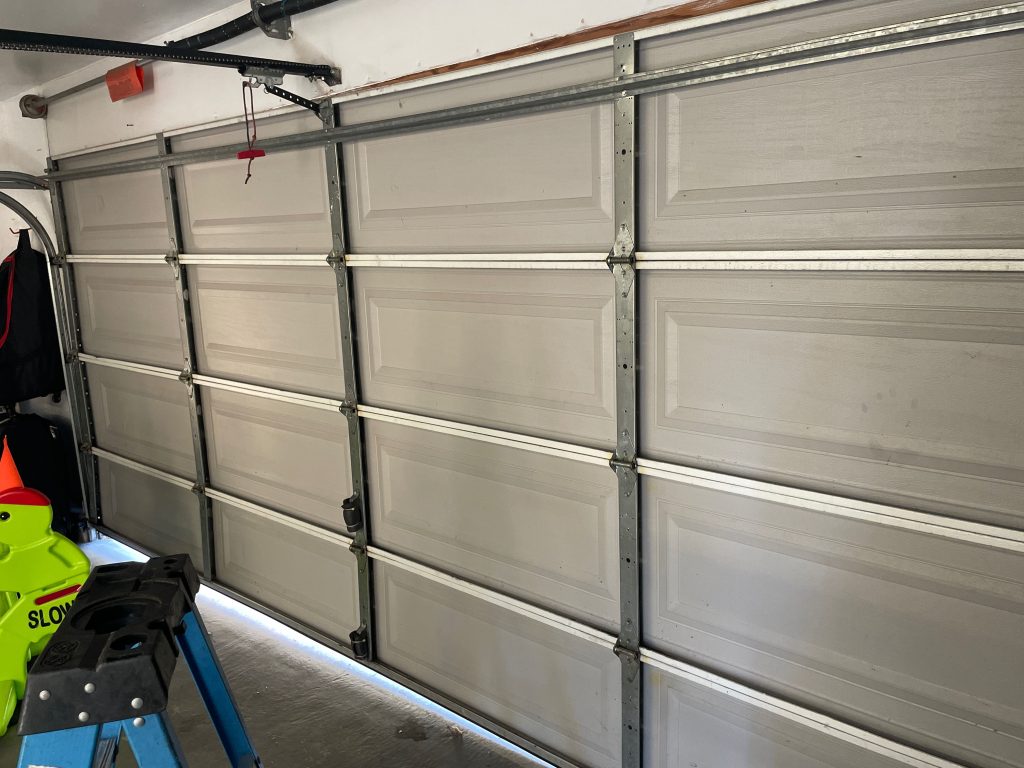
What Misalignment Looks Like Day to Day
The door is louder on one side. Rollers under side load scrub rather than roll, and the sound usually shows up before anything visible does.
One roller is worn flat. Pull the door up by hand and look at the wheels. Uneven wear across a set is a geometry symptom, not a parts quality symptom, as covered in roller wear. Fitting new rollers without correcting the geometry simply restarts the clock.
The door travels crooked. One side leads the other through the opening. Alignment is one cause among several, and garage door travels crooked separates it from cable, drum, and bottom bracket problems.
The door stops at the same point every time. Geometric faults repeat exactly where mechanical ones wander, a pattern covered in door stops at the same spot every time.
Gaps appear at the floor or along a jamb. A door running through a twist will not seat evenly.
The opener strains without any spring problem. Side load is friction, and friction is work the motor has to supply on top of its normal 5% share.
The door has come off track before. Repeat off-track events on a door with sound cables almost always trace back to spacing that is too wide somewhere in the run.
Why Alignment Drifts in Our Service Area
Alignment drift is not random. It tracks the building and the climate, and the patterns differ noticeably between our California and Arizona service areas.
Foundation and slab movement. Sacramento, Stockton, Modesto, Woodland, and Dixon sit on expansive soils that move seasonally. The jamb the track is lagged to moves with the building, and alignment that was correct at install walks out of tolerance over years.
Older framing in the Bay Area. Berkeley, Oakland, Alameda, Martinez, and Burlingame garages were often framed with lumber that has since dried, twisted, and let fasteners loosen. Here the track is usually fine and the wall behind it is not.
Heat cycling in the desert. Phoenix, Scottsdale, Chandler, Las Vegas, and Henderson garages exceed 120°F in summer and reach 130°F in Phoenix. Steel expands, fasteners work, and brackets that were tight in March are loose by August.
Freeze-thaw at elevation. Truckee, South Lake Tahoe, Grass Valley, and Carson City see the same loosening from the opposite direction, with moisture in the fastener holes adding corrosion to the mix.
Vehicle contact. Across every market, the most common single cause is somebody backing into a track. Even a light tap moves a vertical track enough to matter.
The Bottom Line
Track alignment is three separate conditions, and all three have to hold at once. Plumb on the verticals in both planes, level between the two horizontals across the opening, and parallel spacing that stays identical from one end of the run to the other.
The practical test for a homeowner is simpler than the full check. Disconnect the opener, run the door by hand, and watch the gap behind the rollers on both sides. If it changes as the door moves, the geometry is off and no amount of lubricant will settle it.
Track straightening runs $150 to $400 and an off-track correction runs $150 to $400, reaching $1,000 in the worst cases, both as totals including parts, labor, and tax. A tune-up and safety inspection at $95 to $195 includes the alignment check, which is considerably cheaper than the roller and hinge replacement that misalignment eventually causes.
Call us at 866-337-1631,
email info@localgaragedoors.com.
🗓️Book an appointment online — same-day service available across California, Nevada, and Arizona.
Fully Licensed, CA #1023930 | NV #0087802 | AZ ROC #356696
Frequently Asked Questions About Garage Door Track Alignment
How do I align my garage door tracks?
Disconnect the opener, loosen the track brackets slightly rather than fully, bring the track to plumb with a level held against both faces, confirm the spacing matches the opposite side at several heights, then retighten and run the door by hand. Fully loosening a bracket while the door is in the track is how a door comes down, so the work is done with the door closed and supported.
Are garage door tracks supposed to be level?
The vertical sections should be plumb rather than level, and the two horizontal tracks should be level with each other across the opening. Along their length, the horizontal tracks are intentionally pitched slightly downward toward the rear, so a level held along that run will correctly read off.
Should garage door tracks be parallel?
Yes, and this is the check most often skipped. The spacing between the left and right tracks should be identical at the bottom, middle, and top of the vertical run, and along the horizontal run as well. Converging tracks bind the rollers and diverging tracks let the door come out of the track entirely.
How to fix a misaligned garage door track?
Minor drift is corrected by loosening the mounting brackets, repositioning the track to plumb and correct spacing, and retightening into solid framing. If the track itself is bent, repositioning will not help and the section needs straightening or replacement. If the jamb has moved or the lags no longer hold, the fix is structural rather than adjustment.
Can I fix my garage door alignment myself?
Checking it is reasonable for a confident homeowner with a level and a tape measure, and worth doing. Adjusting it is riskier than it looks, because the track is what holds a 130 to 400 pound door in place and the springs above it store 200 to 300 foot-pounds of torque. Measure first, and if more than one bracket needs moving, that is the point to stop.
How to fix a garage door that is slightly crooked?
Start by identifying whether the door is crooked while moving or crooked at rest. Crooked at rest usually points to cable tension or a drum that has slipped. Crooked only while moving points to alignment or a binding roller. The diagnostic split is covered in garage door travels crooked, and running the door by hand with the opener disconnected is the fastest way to tell them apart.
Related Articles:
- Garage Door Travels Crooked: Cable, Drum, Bottom Bracket and Track Alignment Clues
- Why the Garage Door Binds Near the Top: Radius, Back-Hang and Track Pitch
- Track Radius 12″ vs 15″: How It Changes Door Travel, Headroom and Opener Fit
- Door Stops at the Same Spot Every Time: Track Damage vs Panel Flex vs Obstruction